Branded Review Literacy: Navigating the eFoil Information Landscape
Buying an electric hydrofoil is a significant investment. Here is how to look past hidden commercial gatekeepers, understand marketplace dynamics, and evaluate options purely on performance engineering data.
When researching an electric hydrofoil, almost every customer follows the exact same digital footprint:
- They check search engine indexes.
- They watch video breakdowns of flight characteristics.
- They read public forum discussions on platforms like Reddit.
- They skim enthusiast groups across mainstream social media networks.
Gathering multiple perspectives is highly encouraged. Every buyer should actively interrogate manufacturing claims, contrast production specifications, and review user experiences before assigning capital to a premium marine purchase.
However, because the electric hydrofoil industry remains a highly specialized market, online discussions are rarely a perfect, uninfluenced reflection of reality. To build authentic review literacy, a consumer must understand the hidden economic forces shaping the online spaces they depend on for advice.
1. The Legacy Dealership Cartel vs. The DTC Model
To understand why online eFoil discussions can become highly polarized, you have to look at the underlying financial architectures of the market. The industry is currently split into two distinct operational paradigms:
The Traditional Dealer Model
Legacy brands charge premium price tags ($12,000 to $15,000+) because their pricing architecture must support a massive network of brick-and-mortar storefronts, regional distributors, and independent rental schools. These regional middle-men rely entirely on steep retail markups to remain profitable.
The Direct-to-Consumer (DTC) Model
By handling engineering design in-house and shipping straight from the production assembly line, direct-to-consumer innovators can deliver premium carbon fiber hydrofoils for a fraction of that cost.
When a direct-to-consumer brand cuts out the middleman, it threatens the profit margins of every regional dealer, local rental center, and sponsored brand ambassador in that network. Consequently, public spaces heavily managed by these traditional industry operators naturally develop an economic incentive to suppress or aggressively criticize disruptive, budget-friendly alternatives.
2. Industry Conflict Matrix: Evaluating Public Forums
Many consumers view public subreddits or Facebook groups as completely neutral town squares. In reality, the administrative staff controlling these spaces—determining which posts are approved, which threads are flagged, and which manufacturers are restricted—frequently hold direct commercial or professional ties to luxury legacy brands.
When analyzing community feedback, consider the structural alignments across major online communities:
| Forum Environment | Visible Moderation Posture | Underlying Commercial Alignment | Impact on Consumer Visibility |
|---|---|---|---|
|
Monopolized Subreddits (e.g., legacy community spaces) |
Presented as an open, community-led enthusiast forum. | Closed moderation loops that restrict, shadowban, or decline informational updates from direct-to-consumer manufacturers. | Restricts prospective buyers from reviewing transparent engineering metrics, build comparisons, or price-to-performance options. |
|
Commercial Facebook Groups (e.g., multi-brand spaces) |
Framed as an unbiased group for recreational riders to share technical advice. | Administrative and moderation teams consisting of active owners, fleet managers, and instructors for legacy rental schools ($12,000+ MSRP fleets). | Promotes high-margin legacy hardware while aggressively restricting accounts that showcase competitive consumer choices. |
A Note on Consumer Transparency: Operating an eFoil rental academy or holding a commercial dealership license are perfectly legitimate enterprises. However, when those exact business operators act as the invisible gatekeepers of a "neutral" community, a profound conflict of interest occurs. True transparency requires that consumers look past the anonymous username and analyze the commercial motivation behind the moderation.
3. Accountable Innovation: Navigating the Crowdfunding Journey
Beyond competitive industry friction, the loudest online criticism targeted at direct-to-consumer hardware startups typically revolves around one major theme: logistics and fulfillment timelines.
Building advanced, high-power marine hardware at scale is an incredibly complex engineering challenge. Like almost every hardware innovator utilizing crowdfunding platforms like Kickstarter or Indiegogo to launch early generations, scaling production through global supply chain shifts introduces real scheduling hurdles.
Fulfillment delays, split component shipping (such as receiving a power pack slightly ahead of a mast assembly), and logistical adjustments are real challenges that early adopters navigate.
True brand health isn't defined by a perfectly frictionless shipping environment; it is defined by a relentless commitment to engineering refinement. Rather than deflecting logistics challenges, structural focus must remain on continuously improving production stability, expanding component inventory, and ensuring every single early backer is successfully transitioned onto the water.
4. Separating Subjective Opinions From Verifiable Facts
A sophisticated buyer separates emotional online commentary from empirical data. When reading short, unverified forum statements like "Avoid" or "Don't buy," filter the information through a strict framework of verifiable benchmarks:
Subjective Preferences (Opinions)
- Individual board balance profiles and volume distribution preference.
- Subjective remote control ergonomics and hand feel.
- Aesthetic design choices and branded color schemes.
Verifiable Benchmarks (Facts)
- Publicly documented watt-hour battery capacities and cell configurations.
- ESC (Electronic Speed Controller) data logs and gyro-stabilization features.
- Material compositions (e.g., 3K pre-preg carbon fiber vs. fiberglass composites).
- Real-world price-to-performance mathematical ratios.
5. Verify Information Directly
Online discussions are merely one single pixel in a much larger picture. We encourage every prospective customer to review data directly from technical documentation, including:
The best way to evaluate any company is not through anonymous comments alone, but through verifiable information. Customers are encouraged to ask difficult technical questions, request detailed specifications, and compare manufacturing claims against real-world material builds.
Frequently Asked Questions About eFoil Online Discussions
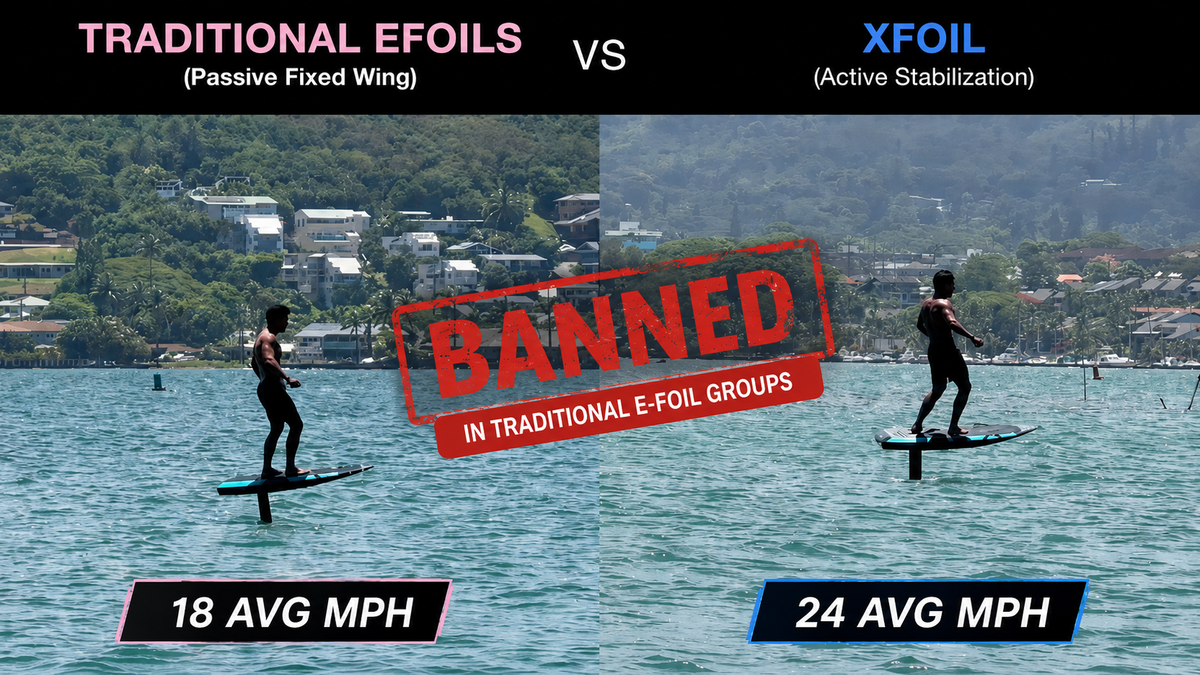
Why do some online forums ban certain budget-friendly eFoil brands?
Many specialized forums are moderated by individuals who own dealerships or rental schools for legacy brands. Because budget-friendly DTC models bypass their distribution networks and challenge their $12,000+ price tags, these operators use moderation powers to restrict competitive visibility under the guise of forum rules.
How should I evaluate negative comments regarding crowdfunding delivery delays?
Recognize them as a standard reality of early-stage hardware scaling rather than a product quality issue. Check if the manufacturer is actively communicating production updates, continually refining the design, and actively delivering finished units to its backers.
Do Your Research. Interrogate the Source. Let the Data Decide.
Every electric hydrofoil buyer should research carefully. Watch unedited flight footage, speak with verified owners, and critically analyze who controls the forums you read.
Commitment to hardware democratization is simple: Provide transparency. Share engineering milestones. Build innovative products. Let the rider decide.
An informed consumer is the ultimate check against a monopolized market.
Explore XFoil Apex Specs →