Adaptive Wing vs. Fixed Wing eFoils: The Next Evolution in Electric Hydrofoil Technology
When researching an electric hydrofoil, you’ll quickly notice that most eFoils use a traditional fixed-wing design. Companies such as Lift, Fliteboard, Waydoo, and others have helped grow the sport using this proven approach.
But fixed wings require riders to make compromises.
- Choose a larger wing: You’ll typically enjoy easier takeoffs and greater low-speed stability—but with increased drag as speed rises.
- Choose a smaller wing: You’ll generally gain higher top speeds and a more agile feel—but you’ll often need more speed, power, and rider skill to get on foil.
At XFoil, we asked a simple engineering question: What if one wing could adapt throughout the ride instead of remaining fixed?
The result is the XFoil Adaptive Wing System—an electric hydrofoil technology designed to optimize lift, drag, and ride characteristics across a wide range of riding conditions.
What Is an Adaptive Wing on an Electric Hydrofoil?
A traditional eFoil uses a rigid hydrofoil wing with a fixed shape. Once you launch, that wing maintains the same geometry throughout your ride.
The XFoil Adaptive Wing System is designed to change its hydrodynamic profile as riding conditions change. Rather than optimizing performance for only one speed range, the system is engineered to provide:
- Efficient low-speed lift during takeoff
- Reduced drag as speed increases
- Smoother transitions throughout acceleration
- Greater versatility from a single wing setup
Why Fixed-Wing eFoils Require Trade-Offs
Every fixed-wing electric hydrofoil is designed around compromise.
A large wing generally provides earlier takeoff, more lift, and greater low-speed stability. However, larger wings also generate additional drag at higher speeds.
A smaller wing generally provides lower drag, faster top speeds, and quicker turning response. However, it typically requires more rider input and higher speed to lift onto foil.
Many riders own multiple wings so they can change setups depending on water conditions and riding style. The Adaptive Wing System was designed to reduce these compromises by adapting throughout the ride.
Why Stability Matters on an eFoil
Unlike wing foiling or kite foiling, an electric hydrofoil has no sail or kite providing an external point of support. The rider balances entirely on the hydrofoil while the propulsion system moves the board through the water.
Every wave, piece of chop, and change in water flow influences how the board responds. Improving stability isn’t simply about comfort—it affects rider confidence, efficiency, and overall control.
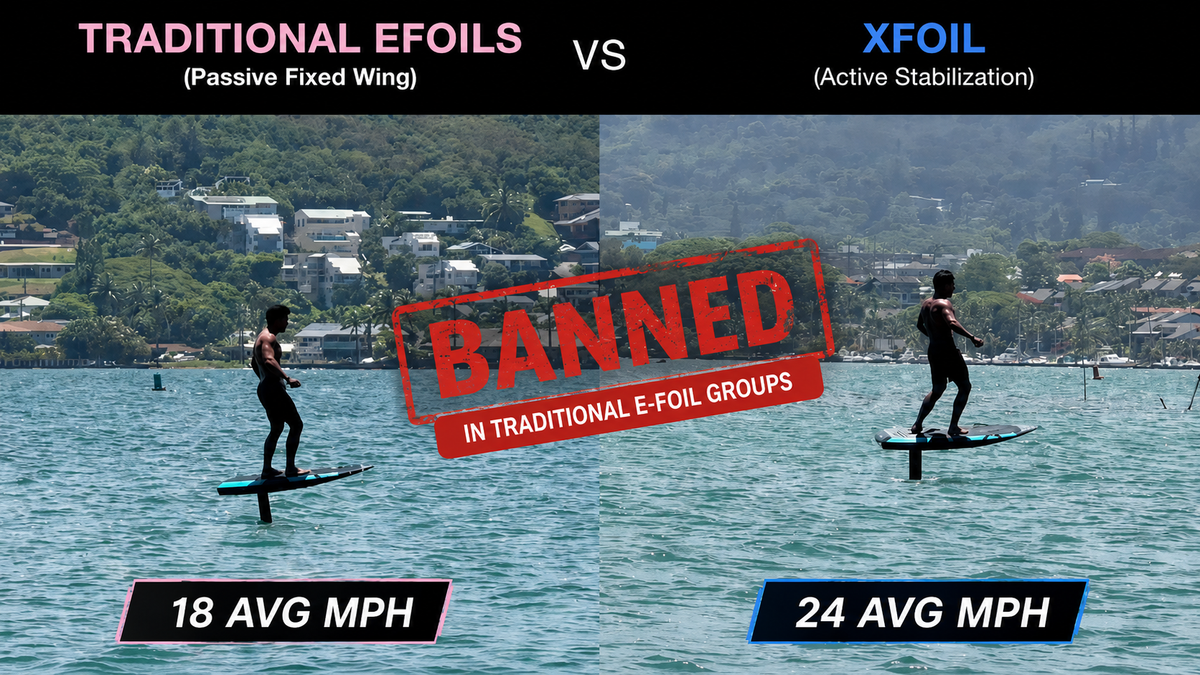
Adaptive Wing vs. Fixed Wing: See the Difference
Adaptive Wing vs. Fixed Wing Side-by-Side Comparison: Compare two different design approaches during takeoff, acceleration, and cruising. Watch how each system responds as speed increases and observe the differences in lift and drag characteristics.
Designed for Efficiency Across the Entire Ride
Rather than optimizing only for takeoff or only for top speed, the Adaptive Wing System is designed to perform across the entire riding experience. Potential advantages include:
- Improved low-speed lift
- Reduced hydrodynamic drag
- Greater efficiency across different speeds
- Increased versatility from a single wing configuration
Actual performance will vary depending on rider weight, water conditions, riding style, and equipment configuration.
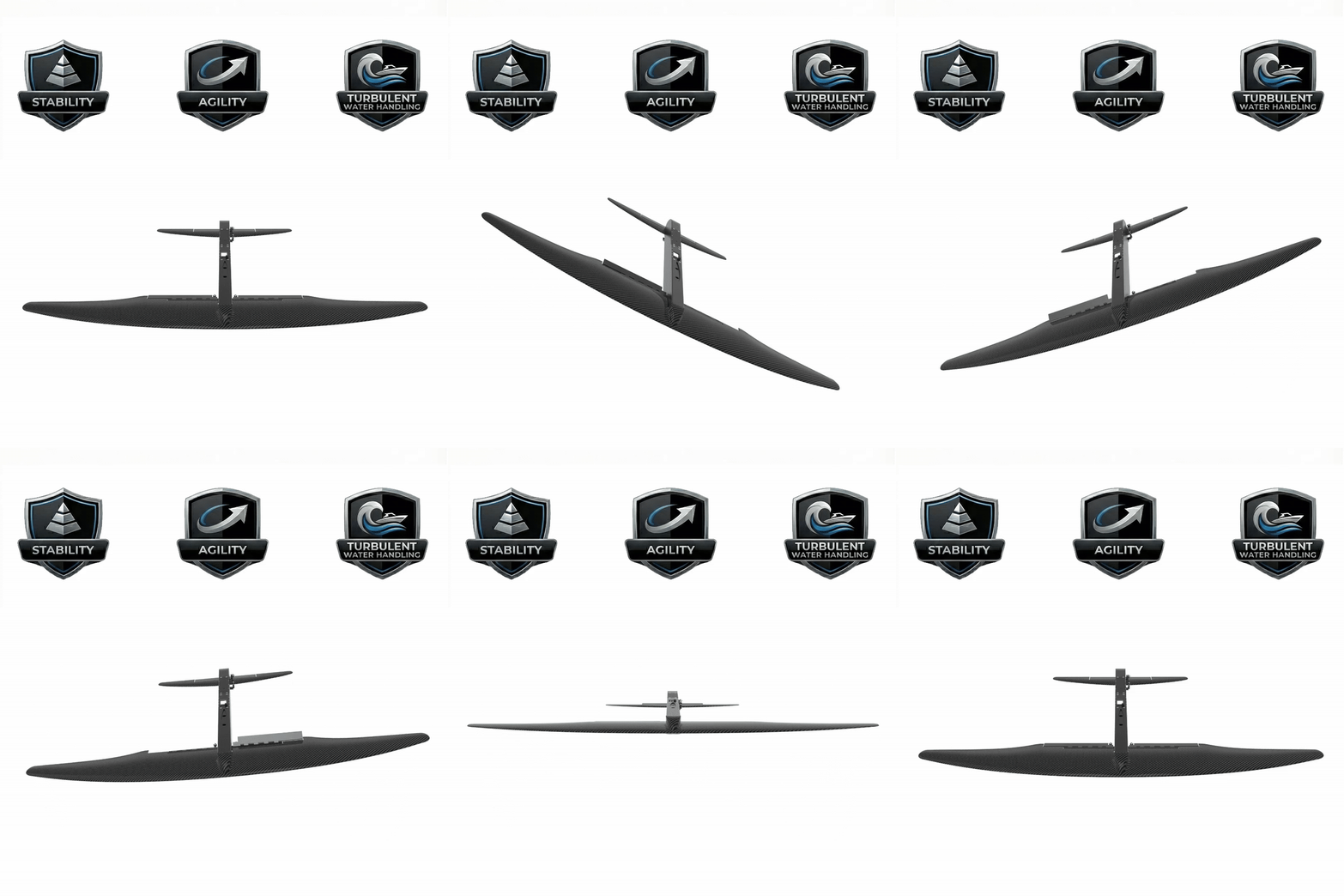
Demonstrating Dynamic Stability
To better illustrate adaptive wing behavior, we also performed demonstration testing without a rider on the board. These demonstrations are intended to show how different wing designs respond to changing water conditions under controlled testing.
Adaptive Wing Stability Demonstration (No Rider): Observe how the adaptive wing responds to changing water conditions during an unmanned demonstration. Testing is intended to illustrate design characteristics and should not be interpreted as representing all real-world riding conditions.
A Different Approach to Electric Hydrofoil Design
Innovation in electric hydrofoils continues to evolve. Traditional fixed-wing designs have introduced thousands of riders to the sport and remain an important part of the industry.
The XFoil Adaptive Wing System explores a different engineering philosophy by allowing the hydrofoil to adapt throughout the ride rather than relying on a single fixed geometry.
Our objective is simple: Help riders enjoy smoother launches, efficient cruising, responsive handling, and a versatile riding experience without constantly changing wing configurations.
Frequently Asked Questions
What is an adaptive wing on an eFoil?
An adaptive wing features active moving control surfaces guided by onboard sensors. Instead of maintaining a single static shape like a traditional eFoil, it dynamically adjusts its hydrodynamic profile in real time to optimize lift, balance, and drag across all riding speeds.
How is an adaptive wing different from a fixed wing?
A fixed wing relies entirely on rigid, passive geometry—meaning stability depends on the rider making physical micro-corrections. An adaptive wing replaces physical struggle with software-governed active stabilization, balancing pitch, roll, and yaw up to 1,000 times per second to eliminate choppy hull movement and unpredictable nose-climbs.
Can one adaptive wing replace multiple fixed wings?
Yes, absolutely. Because the Adaptive Wing System is virtually programmable through our user interface, you can adjust stability profiles, gyro assistance, agility, and input sensitivity in real time. Rather than buying and swapping multiple physical wings, a single AWS setup allows you to tune your ride on the fly—from ultra-stable beginner cruising to aggressive, high-performance carving.
Does adaptive wing technology improve battery efficiency?
Yes, significantly. Fixed-wing riders often choose mid-aspect wings for extra stability, but those larger wings create heavy hydrodynamic drag that drains the battery quickly. With AWS, you can pair a highly aggressive, low-drag, high-efficiency wing with active dynamic stabilization. The onboard system stabilizes the ride so it feels as forgiving as a mid-aspect setup while retaining maximum energy efficiency—yielding up to a 25% increase in efficiency and adding up to 30 extra minutes of session time on a single charge.
Learn More
If you’re researching electric hydrofoils, compare technologies, ask questions, watch independent demonstrations, and evaluate products based on engineering, real-world performance, support, and long-term innovation.
At XFoil, we believe informed riders make the best decisions.